
Scientists whisper about magma and time; pilots eye their flight paths; a radio crackles in a fishing village that thought the ground below was history. The question isn’t just what happens next — it’s what a wake‑up this slow tells us about our much faster lives.
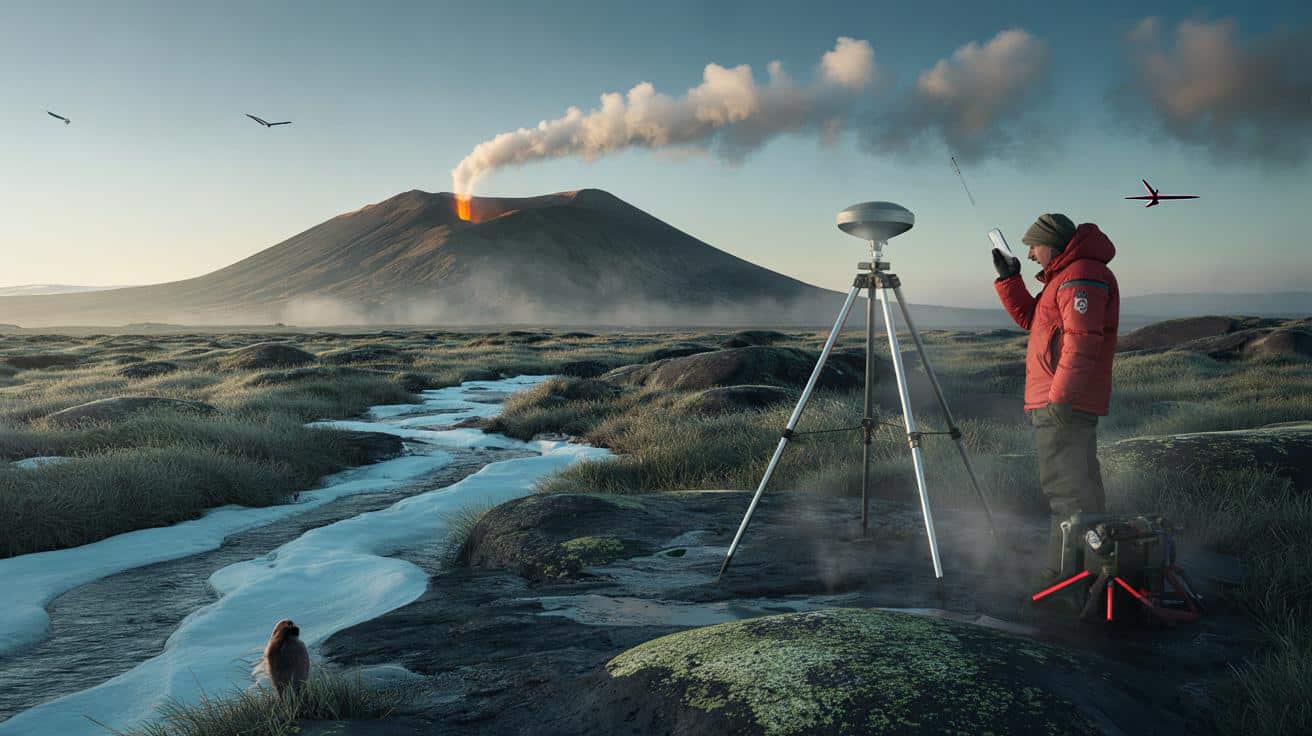
Dawn came cold and colourless, the kind of light that makes basalt look like iron. The glacier‑fed river hissed over stones, and somewhere beneath my boots a tremor ticked through the ground with the gentlest insistence, like a heartbeat you weren’t listening for until it was all you could hear. Up the slope, a new ribbon of steam unravelled from a vent that old maps marked as extinct, while the monitoring screens on the backseat of a dusty pickup began to sketch jittery lines. A raven crossed, hurrying into the grey. I stood there, breath making small clouds, and opened the notebook I’d barely needed yesterday. *The volcano was awake.*
When a sleeping giant rolls over
Up close, awakening is less fireworks and more fidgeting. The **remote volcano** does not burst into spectacle; it frowns, it stretches, it learns its own old pathways again. Sensors tucked into lichen‑slick rock record minute swarms of quakes, each too small for the hand to feel, together as rhythmic as rain. Gas smells sharpen from faint, eggy whispers to a scratch in the nose as CO2 and SO2 seep through thawing soils. GPS pins planted years ago show the ground lifting by centimetres, a deep‑rooted shrug that says magma is moving from wherever it has hidden all this time.
On the coast, the story isn’t told in seismograms but in steps. A fisherman says he saw a fine haze at sunset that wasn’t sea fog, and ash that wasn’t snow dusting his boat cover by morning. The tiny airstrip two valleys away delays a departure while crews wipe sensors, and a schoolteacher explains to her class why the cloud has a different taste today. Meanwhile, the counter on a field laptop creeps from eight microquakes an hour to sixty, and someone mutters the unthinkable number out loud: **700,000 years**. A digit string that doesn’t fit in your mouth but sits stubbornly on your tongue.
Why now? Rocks remember stress like people remember songs. Tectonic plates nudge; fractures heal and reopen; water seeps, boils, alters the plumbing. A mantle plume might have fed this system for ages without a whisper breaking the surface, yet a slight change in pressure — ice thinning by metres over centuries, a faraway quake unzipping an old seam — can tip the balance. None of it feels sudden to a planet that measures in eons. To us, it’s a door we thought bricked shut, rattling on its hinges because the house was quietly settling all along.
Reading the first sentences of an eruption
The method is patient and oddly physical: bring a nose, bring ears, bring satellites. Crews hike in with gas spectrometers and collect air samples upwind and down, learning the volcano’s breath the way a medic learns a pulse. InSAR satellites pass overhead and stitch together weeks of images, turning shadows into millimetres of uplift; tiltmeters blink from the slopes, sending whispers over radio to a trailer warmed by a noisy generator. The point isn’t to guess the exact hour, but to listen for patterns — quakes that change pitch, gas ratios that swing, ground that arches not just here or there but in a coherent swell.
For people living under big skies and low roofs, it becomes daily ritual. Clear gutters; swipe the car’s windscreen; keep a charger in your bag; follow the local survey and the civil protection bulletin, not the rumour mill. We’ve all had that moment when the news app pings and the mind runs to the worst, so it helps to put shape to the unknown. Let’s be honest: nobody really does this every day. But one small kit, one family chat about where to meet if the road closes, one attention paid to wind direction, and you’ve traded helplessness for agency without giving your life to worry.
What trips people up isn’t fear, it’s boredom. A week of tremor with no drama can lull you into thinking the mountain has changed its mind, right until the wind swings and the ash finds your town. Watch the slow signals with the patience they demand, and save the adrenaline for the siren you’ll likely never hear.
“Volcanoes don’t wake angry; they wake complex,” a field geophysicist told me, squinting into vapour that smelled like matches after rain. “Our job is to translate complexity into clear choices.”
- Track: Your national geological survey, the aviation notices, and the local civil protection channel.
- Prepare: Dust masks, eye protection, extra water, and a simple go‑bag with copies of documents.
- Decide: If you travel, choose flexible tickets and check ash advisories the evening before.
- Filter: Share updates from verified sources, not screenshots without context.
The meaning of a very slow alarm
This isn’t the apocalypse. It’s something stranger and more intimate: a reminder that the ground has a memory longer than our myths. Maybe flights will reroute for a time. Maybe fields will get a gritty morning and towns a new conversation about risk and wonder. The most revealing part may be how we respond — whether we can carry both truths at once: that volcanoes feed soil and stories, and that they can also bruise lungs and plans. The world is full of old things learning new tricks, from weather to ice to stone. A volcano that *starts to stir* after half a million years isn’t breaking the rules. It’s reading from a very long book we’re only just learning to hold.
| Point clé | Détail | Intérêt pour le lecteur |
|---|---|---|
| Signals, not surprises | Quake swarms, gas shifts, and ground uplift reveal early activity | Know what matters before dramatic images flood feeds |
| Practical calm | Simple kit, clear info sources, flexible travel choices | Reduce anxiety and disruption with low‑effort habits |
| Time scales | 700,000 years feels huge, yet geology moves step by step | Context replaces fear with perspective and curiosity |
FAQ :
- Is an eruption guaranteed now that the volcano is active?Not guaranteed. Unrest can last days or months, even settle down again. Scientists watch for patterns — sustained tremor, rising gas, consistent uplift — before raising alert levels.
- What does “700,000 years” actually mean here?It’s the estimated time since the last significant eruption. Dormant is not extinct; magma systems can recharge and reconnect over timespans far beyond human history.
- Could this affect flights and engines?Yes if ash reaches cruising altitudes or key air corridors. Aviation agencies issue advisories, and airlines reroute or pause schedules to keep ash away from turbines.
- Will this change the climate?Only a very large, sulphur‑rich eruption would have noticeable cooling effects. Most events are local or regional in impact, with temporary air‑quality and visibility issues.
- How can I follow trustworthy updates?Check your national geological survey, the official volcano observatory page, and civil protection channels. Map apps and social posts are useful, but official bulletins set the baseline.





Goosebumps—700,000 years and now a heartbeat under our feet. Thanks for the vivid field notes; the “signals, not surprises” mantra is definitley sticking with me.