
For many Blue Badge holders, the real budget drain is everyday travel — buses to work, hospital appointments, school gates, the weekly shop. There’s a little-known perk that can turn those fares into £0, and it’s hiding in plain sight.
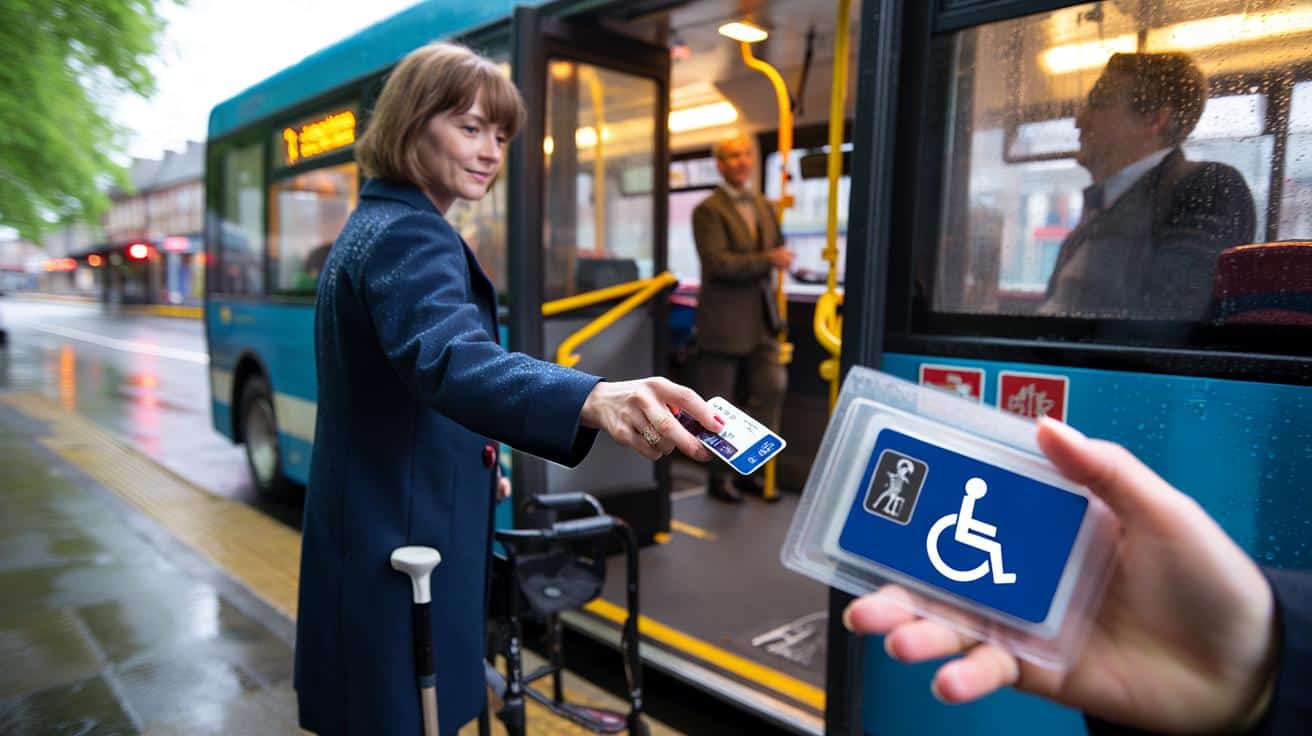
Rain freckles the bus shelter on a Wednesday morning in Stockport. A woman in a navy coat leans on her cane, fishes for a purse, and taps a contactless card that screams 2.80 on the reader. The driver nods, the bus sighs forward, and you can almost hear her mental arithmetic as she adds up the week’s rides.
She had no idea the same journey could be free. I only found out because a neighbour let it slip over the fence, the way people share tomato plants in spring. He said, very casually, “If you’ve got a Blue Badge, you can get a disabled bus pass.” I checked. He was right. It felt like finding a tenner in an old coat.
The free travel perk few Blue Badge holders are claiming
Blue Badge holders are often eligible for a Disabled Person’s Bus Pass — a card that gives free off‑peak bus travel across England under the English National Concessionary Travel Scheme. It runs 9.30am–11pm on weekdays and all day on weekends and bank holidays. Scotland, Wales and Northern Ireland have their own versions, with generous local twists.
In Scotland, the National Entitlement Card covers free bus travel nationwide and companion travel for those who qualify. Wales offers the Concessionary Travel Card, also free on buses, with some rail routes included at certain times. Northern Ireland’s SmartPass fills a similar role. **In London, a Disabled Person’s Freedom Pass unlocks buses, Tube, trams, DLR and most local rail at no cost.** Same idea, different badge.
Here’s the quiet part: many people with a Blue Badge have never been told. There are around 2.5 million Blue Badge holders in England, according to Department for Transport figures, yet only a fraction hold a disabled person’s bus pass. The Blue Badge itself isn’t a bus pass, but it often acts as strong proof for one of the disability categories that do qualify — especially if walking is limited or you meet the criteria for not holding a licence on medical grounds.
What it looks like in real life — and why it’s missed
Think of Maya in Leeds. She uses a rollator, works a few mornings at a charity shop, and zig‑zags to physio on Tuesdays. Before her pass, she spent about £18 a week on buses. After the pass, that dropped to zero in off‑peak hours, and her shop shifted her shifts to fit. “It’s not just money,” she told me. “I say yes to more things.” Small change, big freedom.
We’ve all had that moment when you realise you’ve been paying for something you could have had for free for ages. The mistake is easy to make. Blue Badge and concessionary travel are managed separately, often by different departments inside the same council. The parking badge arrives in the post, and the letter says nothing about buses. You assume you’re not eligible, or you’ll do it later.
The eligibility logic is simple once you see it. The Transport Act sets out categories for disabled travel concessions: blind or partially sighted, profoundly or severely deaf, without speech, substantial walking difficulty, loss of both arms, learning disability, or refused a driving licence on medical grounds. A Blue Badge overlaps with several of those, so the badge can be evidence. **That’s why the pass is called Disabled Person’s, not Blue Badge — the route in is your condition, and the badge can help prove it.**
How to apply in minutes — and what to prepare
Start with your local council website and search “concessionary travel disabled bus pass” plus your area. Most applications are online. You’ll need a passport-style photo, proof of identity, proof of address, and medical evidence. If you hold a Blue Badge, submit both sides as evidence, along with any clinic letters or PIP award pages that mention mobility. It takes 10–20 minutes if you have the files ready.
Don’t overthink the photo. A smartphone snap against a plain wall is fine. Upload clear, uncropped scans or photos of letters; show your name, the condition, and the date. Tick the box for a Companion or “+1” pass if your area offers it and you sometimes need someone to travel with you. Let’s be honest: nobody really does this every day, so set a 30‑minute window and make tea first.
People trip over tiny things. Expired letters. Blurry uploads. Picking the wrong eligibility category when more than one fits. If you’re on PIP, include the mobility descriptors page, not just the award letter. If your council issues temporary passes while checking medical evidence, ask for one to bridge the gap. **Some councils will upgrade you to all‑day local travel by default, others on request — worth a quick look.**
“This isn’t charity,” says Amina, an accessibility adviser who runs drop‑in sessions at a community hub. “It’s access. If travel is a hurdle, the pass is the ramp.”
- England: Disabled Person’s Bus Pass (ENCTS), free off‑peak buses nationwide
- Scotland: National Entitlement Card, free buses and companion travel where eligible
- Wales: Concessionary Travel Card, free buses and some rail at set times
- Northern Ireland: SmartPass, free or discounted travel depending on scheme
- London: Disabled People’s Freedom Pass across TfL and most local rail
Beyond buses — the extras Blue Badge holders can unlock
This is where it gets interesting. In many areas you can add a Plus‑One, so a partner, friend or carer rides free when you do. London’s Disabled People’s Freedom Pass reaches Tube, Rail, DLR and trams, which turns medical appointments into one tap. Community transport schemes will often accept your pass, and some councils extend hours to start earlier than 9.30am for local routes serving hospitals.
There are side perks, too. If your vehicle qualifies for the disabled tax class, you can claim a 100% discount on London’s Congestion Charge after a quick registration, and ULEZ has grace periods and exemptions tied to disability benefits. Some ferry routes in Scotland bring concessions for disabled residents. In Wales, certain valley lines run free for pass holders during off‑peak windows. It’s a patchwork, yes, but a useful one.
I spoke to one dad in Swansea who uses a companion pass for nursery drop‑offs and hospital eye clinic days. He used to budget £40 a week for buses. Now he spends it on swimming lessons. Small frictions lift, and life opens a notch. *Freedom doesn’t arrive with a fanfare — it sneaks in through little doors like this.*
What stays with you after you get the pass
Money saved is the headline, but it’s not the whole story. Travel becomes predictable, and predictable is powerful when you’re managing pain, fatigue or sensory overload. You start saying yes to coffee across town, the mid‑morning class, the better GP slot. You notice how your city strings together when the fares disappear from the equation.
Tell someone else. Tell the neighbour who always carries a stick, the parent in the blue‑striped bay at school, your aunt who gave up driving last winter. Share the link for your council page and sit with them while they upload a photo. **The difference between knowing and claiming is often a ten‑minute nudge.** The badge on your dashboard opens one door. This pass opens another.
| Point clé | Détail | Intérêt pour le lecteur |
|---|---|---|
| Free bus travel with a Disabled Person’s Pass | Off‑peak nationwide in England; similar schemes in Scotland, Wales, NI | Direct savings on everyday journeys |
| Blue Badge as evidence | Often accepted to prove mobility‑related eligibility categories | Simplifies and speeds up the application |
| Extras and local boosts | Companion travel, London Freedom Pass coverage, community transport | Broader independence and flexibility |
FAQ :
- Does having a Blue Badge automatically qualify me for a free bus pass?No, but it’s strong evidence. Eligibility is based on disability criteria; the Badge often helps prove them.
- When can I travel for free in England?From 9.30am to 11pm on weekdays, all day on weekends and bank holidays. Some councils extend hours locally.
- Can someone travel with me for free?Many areas offer a Companion or “+1” pass if you need assistance. Check your council’s policy.
- How do I apply?Apply through your local council’s concessionary travel page. Upload a photo, ID, address, and medical evidence or Blue Badge details.
- Is there anything beyond buses?Yes. London’s Disabled People’s Freedom Pass covers Tube, rail and trams. Some places include limited rail or ferry concessions.








I had no clue the Blue Badge could help prove eligibility for the Disabled Person’s Bus Pass. I’ve been budgeting ~£22 a week for off‑peak rides to physio and the shops; this could be a game‑changer. Quick tip I learned the hard way: keep your PIP mobility page handy, not just the award letter. Thanks for the nudge—bookmarking this to help my neighbour aply too.