
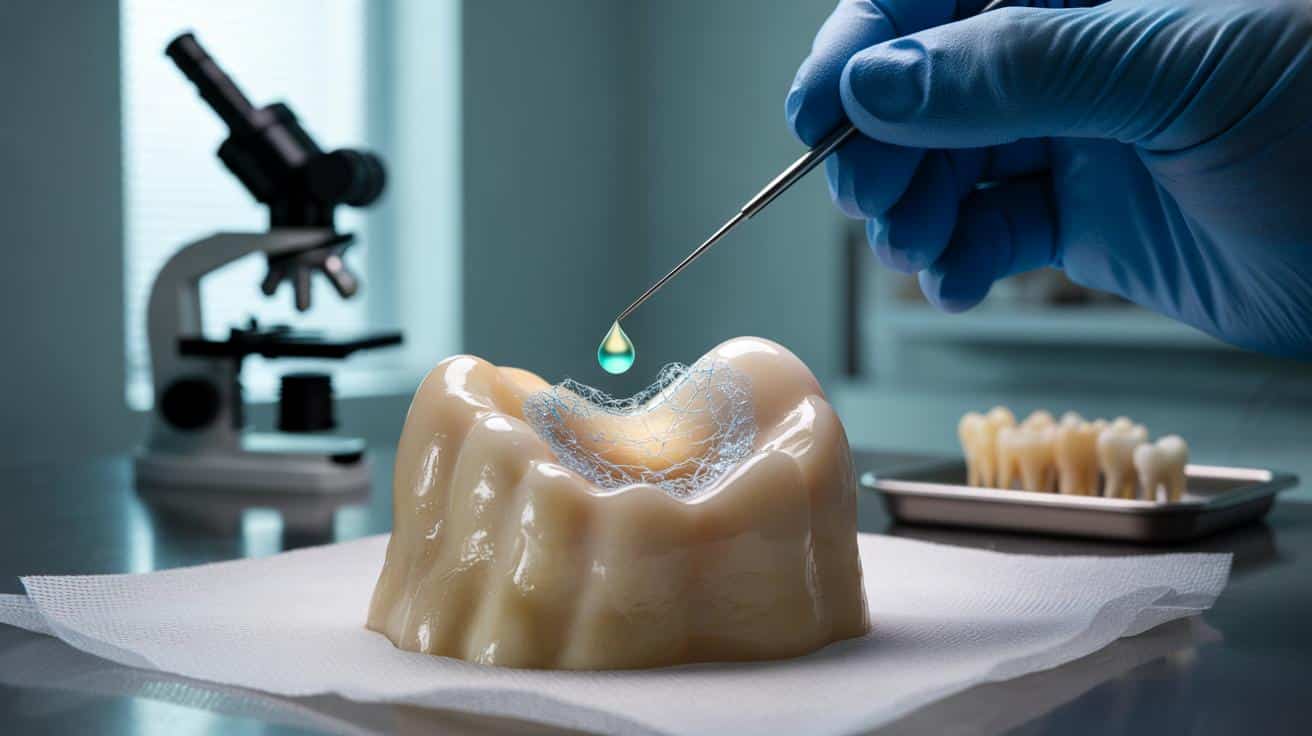
Every coffee, every squeeze of lemon, every rushed brush leaves tiny marks. Dentists can patch, polish, and fill, but the original enamel is gone for good. That’s been the rule since childhood. Now a quiet rule-bender has arrived: a lab-made gel that coaxes enamel to repair itself, crystal by crystal. Researchers are not using hype lightly. They say they’re “excited”. The real question is simple and personal: could this be the moment we stop losing the war against wear?
The researcher slid a small vial across the bench, the liquid inside faintly pearlescent under the strip lights. I’d just come from a routine check-up, tongue probing a familiar rough patch on a back molar. In the lab, a row of extracted teeth sat on gauze like museum pieces from people who still bite their forks. A scientist dabbed the gel on a chalky white spot and angled the microscope so I could see. *It felt like watching frost grow in fast-forward.* A thin, glassy sheen began to knit over the lesion. We’ve all had that moment when an ice-cold sip hits a nerve and your whole jaw winces. What if a gel could cheat biology?
Inside the promise of a self-repairing smile
Tooth enamel is the hardest thing the body makes, a mineral fortress with no living cells to patch a breach. Once acid or abrasion etches it, the damage sits there, catching light and sensitivity. The gel takes the opposite route to a filling. Rather than plugging a hole, it lays down the same building blocks enamel uses — calcium and phosphate — guided by short proteins that act like scaffolding. Under a microscope, you can see order returning to chaos. Not paste, not paint. **Aligned apatite crystals.**
In early experiments, lab teams treated enamel chips cut from extracted molars and premolars — the sort of samples dentists see every day. After repeated dabs, the surfaces looked smoother and less porous, and tiny **microscopic cracks** blurred at the edges. It’s not magic; it’s materials science. Surveys consistently find many adults report sensitivity at some point, and enamel wear patterns are common in people who grind their teeth or sip acidic drinks. Put the two together and you begin to see why this has caught attention beyond dentistry journals.
Here’s the logic. Healthy enamel is a lattice of hydroxyapatite crystals, neatly aligned like a tiled roof. Fluoride helps that roof resist storms, and saliva can redeposit minerals, but only to a shallow depth. The gel mimics the way enamel grows before birth: proteins shepherd minerals into position, encouraging new crystals to fuse to the old lattice. That’s why researchers keep emphasising the word “repair” rather than “coat”. A varnish can flake; a bonded lattice behaves like the real thing. This is the difference between sticking on a patch and mending the fabric.
Using the gel: what a realistic routine could look like
If and when this gel moves from lab bench to bathroom shelf, the routine won’t look far from a normal evening. Brush gently with a soft brush. Spit, don’t rinse. Then a pea-sized dab of gel massaged over a sensitive spot for a minute, letting the mouth stay still so the film can settle. Some versions may use a tray or a strip to hold the gel against the enamel for longer, especially for people with night-time grinding. Think of it as a short, quiet appointment at home.
There are still rules for the mouth’s chemistry set. Acid softens enamel. Wait after fizzy drinks or citrus before brushing and before using any remineralising gel. Let saliva do its first job. Let’s be honest: nobody actually does that every day. If a gel can help rebuild after the occasional lapse, it’s a safety net, not a licence to hammer through a litre of cola. Dentists will likely start with clinics applying it in short courses, then send people home with a follow-up pack.
Regulators will want evidence on two fronts: that crystals formed are stable under real chewing and that the gel plays nicely with fillings, whitening agents, and fluoride. These are not small asks, yet early data hints at compatibility. Dentists I spoke to are upbeat, but they’re cautious by nature, and right to be.
“The goal isn’t to grow new teeth,” one clinician told me, “it’s to heal micro-damage before it becomes a drill appointment.”
- What it targets: early enamel lesions, sensitivity, and shallow wear.
- What it can’t do: fix large cavities or replace missing enamel on biting edges.
- Where it might start: dental surgeries, then approved home-use kits.
- Timeframe: pilot trials first, mainstream only after safety and durability data.
- Pairing: works alongside fluoride toothpaste, not instead of it.
Why this matters, far beyond whiter teeth
Enamel loss is slow, almost sneaky, until one day the dentist taps a probe and you flinch. A gel that can nudge the mouth back towards balance changes that timeline. It shifts the story from “watch and wait” to “repair and protect”. The bigger story sits outside dentistry. We’re learning to persuade the body’s materials to behave like themselves again. The same mindset is showing up in bone-healing cements and cornea-mending drops. **From lab bench to bathroom shelf** is more than a headline — it’s an idea about care that’s earlier, gentler, and less invasive. It won’t cure midnight stress-grinding or sugar cravings. It might make the consequences less permanent.
| Point clé | Détail | Intérêt pour le lecteur |
|---|---|---|
| What the gel does | Guides calcium and phosphate to form enamel-like crystals that bond to existing enamel | Genuine repair potential, not just a temporary coating |
| Where it fits | Early lesions, sensitivity, and prevention between check-ups | Fewer fillings and less chair-time in the long run |
| What to expect next | Clinical trials, regulatory review, phased rollout via dentists then retail | Realistic timeline and how to be first in line |
FAQ :
- Does the gel actually regrow enamel?It doesn’t sprout new teeth, but it can encourage enamel-like crystals to form and fuse to the surface. Think of it as repairing the roof tile-by-tile rather than building a new house. The best results are on early wear and shallow lesions.
- Is it safe for daily use?Safety depends on the specific formula. Early prototypes are designed to be gentle and to work alongside fluoride toothpaste. Expect dentists and regulators to specify how often and where to apply it once trial data lands.
- Will this replace fillings?No. Fillings repair deeper decay where enamel and dentine are gone. The gel is for micro-damage and sensitivity, ideally before a cavity forms. In some cases it may reduce the need for a filling later by stabilising a weak spot now.
- How is it different from fluoride or whitening gels?Fluoride strengthens enamel’s resistance to acid and supports natural remineralisation. This gel tries to rebuild the enamel lattice more directly using mineral-building blocks and guiding proteins. Whitening gels change colour, not structure.
- When will I be able to buy it?Timelines vary. First come controlled studies, then approvals, then limited clinical use. After that, a home-use version may follow. If you’re keen, ask your dentist to flag early offerings backed by peer-reviewed evidence rather than glossy packaging.







If they can truly align apatite crystals and fuse them to the existing lattice, that’s not just a varnish—it’s repair. I get that extracted teeth ≠ living mouths, but as a bruxer with zingy cold sensitivity, even small gains matter. Curious about long-term abrasion tests, diet acid challenges, and whether trays help for grinders. Please don’t hype this into a whitening fad before trials finish.
Is there any peer-reviewed human data (not just extracted molars) showing durability under chewing and acid cycles? “Repair” has been overused before. Links, please?