
Radiators glow, the boiler hums, and yet there’s that stubborn cold pocket by the sofa or the side of the bed. The fix isn’t a pricey gadget or a plumbing overhaul. It’s sitting in your bedroom already — and once you place it on the radiator, the whole room wakes up.
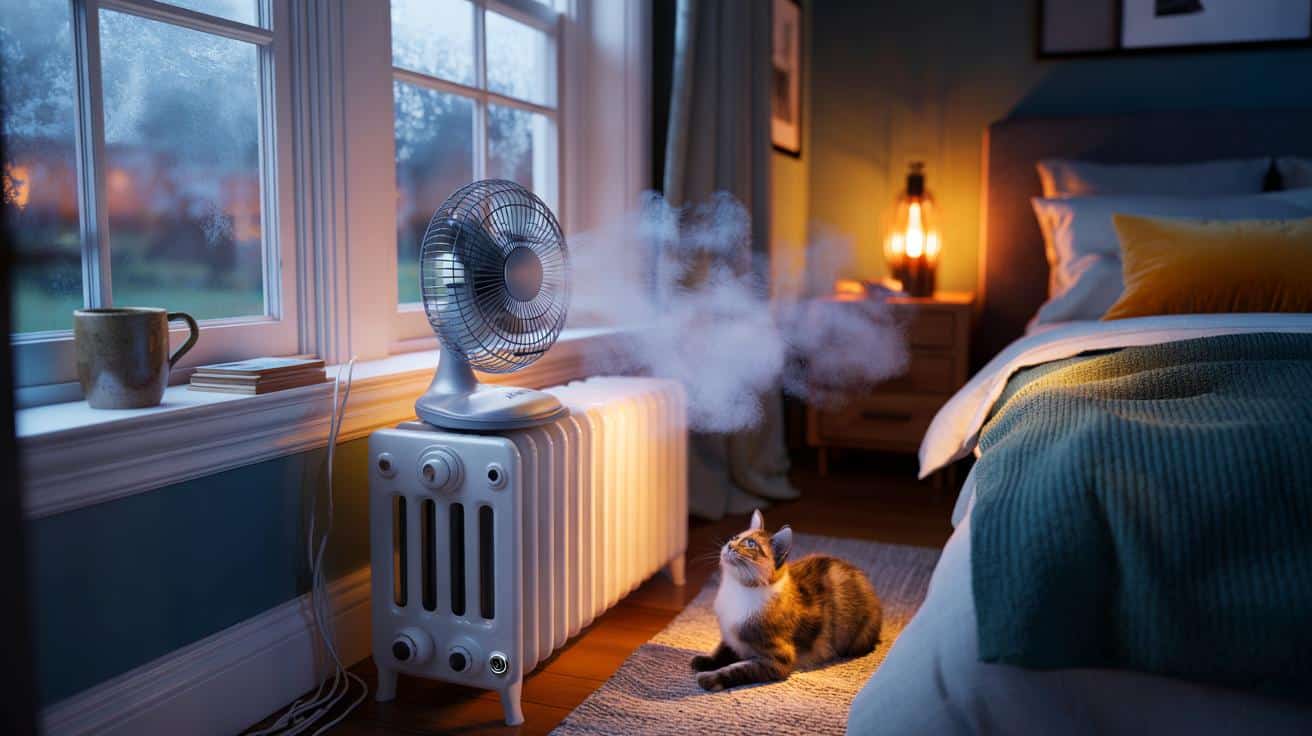
The first time I tried it was on a biting Tuesday in Leeds, the kind of night where the windows fog and your hands hover over the kettle. I set a small bedside fan on top of the radiator, angled slightly upward, and flicked it to the lowest setting. Within two minutes, a soft river of warm air rolled across the room. The cold corner by the wardrobe softened. My toes thawed. It felt like somebody turned a dial I didn’t know existed. The cat moved first, then I did. The fan stayed.
Why a tiny bedroom fan turns a sleepy radiator into a room-warmer
Radiators heat by convection: warm air rises, cool air sinks. Trouble is, that cycle can be lazy. Heat pools near the radiator, drifts up to the ceiling, and leaves the middle of the room lukewarm. Place **a small bedside fan** on the radiator and you change the game. It nudges that warm air outward, fast, and spreads it where you actually sit and live.
I watched it happen in a typical UK bedroom with sash windows and a single panel radiator. Starting at 16°C, the fan on low pushed warm air towards the bed, not just up the curtains. The room reached 19°C in 20 minutes, then 20°C before half an episode of telly. Without the fan, it took close to 35 minutes and still felt patchy. Numbers will vary by house and weather, but the feeling is unmistakable: **warmer faster**.
The science is quietly simple. Radiators sit in a blanket of slow-moving warm air, called a boundary layer. A gentle fan thins that blanket and swaps it for cooler room air more quickly, increasing the radiator’s heat transfer. At the same time, it breaks up stratification — that annoying layer of hot air that lives near the ceiling while your socks freeze. Better mixing means you can often feel comfy at a slightly lower thermostat setting. And yes, **lowering your thermostat by 1°C** is commonly quoted to shave around 10% off heating energy in a typical UK home.
How to set it up in a minute, and what to avoid
Grab a small tabletop or clip-on fan — the sort that lives on a nightstand in summer. Sit it on the radiator’s flat top, on a shelf just above, or on the windowsill that hugs the radiator. Point it across the fins or very slightly upward into the room. Use the lowest speed. You’ll feel a gentle push of warmth, not a gale. A 5–15 W fan costs pennies to run and does more for comfort than you’d think.
Keep the fan stable and clear of fabric. Don’t drape towels or clothes over the radiator while the fan runs; you’ll trap heat and add damp. If it’s a deep convector radiator, aim the airflow along the top grill to carry that heat out. For a slim single panel, angle the fan across the face to sweep warmth into the room. Let’s be honest: nobody moves furniture just to help a radiator every single day. So place the fan where you can set it and forget it.
Think of speed like seasoning — a little goes a long way. High speed can feel drafty and not cosy. Low speed blends the room quietly. Keep cords away from hot copper pipes and valves, and give yourself a clear line of air, not into thick curtains. If you use an oil-filled plug-in radiator in a guest room, the same trick applies. In smaller spaces, a USB fan is enough.
“You’re not cooling the room; you’re moving the warmth to where your body is,” a veteran heating engineer told me. “That’s the difference you actually feel.”
- Place on top, a shelf above, or a sturdy windowsill, not on the floor.
- Low speed for comfort; medium only to kick-start on very cold nights.
- Keep textiles clear; aim the flow into open space, not into drapes.
- Use a timer plug for 30–60 minutes at bedtime or early morning.
- Pair with radiator reflector foil behind external-wall radiators for a double win.
The bigger picture: comfort, bills, and that cosy feeling you remember
What this little bedroom fan does is cut the time you spend waiting. Waiting for the chill to leave the carpet. Waiting for the bed to stop feeling like a cold lake. When the room warms evenly, you relax sooner. You might nudge the thermostat down a notch and not even notice. That’s how quiet savings happen — not in a spreadsheet, but in a feeling.
We’ve all had that moment when you walk into a living room, the radiator’s hot, and the air somehow isn’t. This trick closes the gap between what the boiler does and what your body feels. *Quietly life-changing*. It won’t fix a broken valve or leaky windows, but it will make a decent radiator feel like a better one.
I’ve seen the fan trick turn a chilly box room into a workable home office in January. I’ve seen kids’ bedtime battles shorten because the room stops feeling “cold on my legs.” You don’t need fancy airflow graphs to test it. Try the fan on low, leave it for a quarter of an hour, and walk back into the room. Your nose and fingers will tell you the truth before any thermometer does.
| Point clé | Détail | Intérêt pour le lecteur |
|---|---|---|
| Use a small fan on the radiator | Place on top, shelf above, or nearby sill; aim across fins on low speed | Faster, more even warmth where you sit and sleep |
| Beat heat stratification | Mixes ceiling heat down to people level without a draught | Feels cosier at a lower thermostat setting |
| Pair with simple tweaks | Keep curtains off the radiator, consider reflector foil on external walls | Stack small gains that add up on your bill |
FAQ :
- Does a fan on a radiator waste energy?A small fan uses very little power (often 5–15 W). If it helps you feel warm sooner or run the thermostat a touch lower, it can save energy overall.
- Where exactly should I point the fan?Across the top grill or the radiator face, slightly upward into open space. Avoid blasting into curtains or straight at your face.
- Will this work with all radiators?It works with most water-filled panel and column radiators, and with oil-filled electric ones. For electric convectors with built-in fans, you don’t need an extra fan.
- Is it safe to put a fan on a hot radiator?Standard plastic fans tolerate typical radiator temperatures. Keep cords tidy, avoid fabric contact, and don’t cover vents or grills.
- Can I use a ceiling fan instead?Yes, on low and in winter mode, ceiling fans push warm air down. The bedside fan is simpler and targets warmth immediately where you need it.







I tried this tonight in a chilly 1930s semi: little USB desk fan perched on the radiator, low speed, angled slightly up. Honestly, the cold corner by the bookcase vanished in about 10 minutes and I nudged the thermostat down from 20°C to 19°C without noticing. Costs pennies to run, too. I was sceptical but it’s like turning a sleepy rad into a space heater. Only caveat: keep cables off the hot pipes, learned that the hard way—softened insulation, whoops.
Plastic fan on a hot rad—won’t the base warp over time?